
Compare
Ilum vs Amazon EMR: an EMR alternative on your own Kubernetes.
Amazon EMR is a managed service of AWS that runs Spark on EC2, on EKS or serverless. Ilum Community runs every part, its console included, on a Kubernetes cluster you operate, with no platform fee.
One Spark month, four ways.
50 m6i.4xlarge nodes, 8 h a day, 30 days. List prices on 25 November 2026, us-east-1, on-demand. USD a month.
Amazon EMR on EC2fee per instance-hour
11,520.00
Amazon EMR on EKSfee per vCPU-hour and GB-hour
11,245.54
Amazon EMR ServerlessvCPU and memory, no EC2 under it
14,541.70
Ilum Communityon EKS, no platform fee
9,621.72
ComputeEMR feeEKS clusterIlum’s own services
Where does each part run?
Pick a way to run Spark. Each part moves to where it runs and says who runs it.
Nothing of Ilum runs here.
Console and API
AWS runs itYours to runThe EMR serviceYour Kubernetes cluster
The EMR console and its API at the Region’s endpoint. With its service role, EMR provisions the cluster’s EC2 instances.
The EMR console and the emr-containers API at the Region’s endpoint. It takes your job runs and asks EKS to schedule their pods.
EMR Studio, its console, and the EMR Serverless API. You create an application there and submit jobs to it.
The console, the REST API and the module manager are pods of one Helm release in your cluster.
ilum-uiilum-coreilum-apiNodes
AWS runs itYours to runYour AWS accountThe EMR serviceYour Kubernetes cluster
EC2 instances in your account, in a VPC subnet of yours. EMR provisions them, and you keep the cluster updated.
An EKS cluster you create, with compute from EC2 or Fargate that EKS brings online for each job.
No cluster to operate. EMR Serverless provisions workers for each job, scales them and decommissions them when it ends.
The nodes of the Kubernetes cluster you install it on: EKS, GKE, AKS, OpenShift or bare metal.
Spark drivers and executors
AWS runs itYours to runYour AWS accountThe EMR serviceYour Kubernetes cluster
EMR installs Spark and the other applications you pick on the nodes, and Spark runs on YARN.
For each job EMR on EKS builds a container with Spark, run as pods in a namespace of yours registered as a virtual cluster.
Spark runs on the workers of your application, in a secure VPC apart from other applications.
Driver and executor pods that ilum-core starts in your cluster from the Spark 4 image.
Spark history and logs
AWS runs itYours to runThe EMR serviceYour Kubernetes cluster
A Spark History Server hosted off-cluster, on event logs in an EMR system bucket, for 30 days. Container logs go to your bucket.
A Spark History Server in the EMR console takes the logs by default and shows finished jobs. S3 and CloudWatch are options.
EMR managed storage keeps the logs for up to 30 days, behind the built-in application UIs. S3 and CloudWatch are options.
The Spark History Server of the release, in your cluster, with event logs in the cluster’s default storage.
ilum-history-serverTable files and catalog
Yours to runYour AWS accountYour Kubernetes cluster
Files in Amazon S3, and their tables in the AWS Glue Data Catalog, one per account and Region.
Files go to the MinIO of the release or to storage of yours on S3, GCS, Azure or HDFS. The Hive Metastore of the release registers them.
ilum-minioilum-hive-metastore
What crosses between the two
An agent on each node communicates with Amazon EMR, and a cluster in a private subnet needs a route to Amazon S3 for the buckets EMR requires. Spark event logs go to an EMR system bucket.
Once you enable cluster access for it, EMR on EKS has the Kubernetes scheduler of your cluster place each job’s pods. Logs go to the Spark History Server in the EMR console.
With VPC access set up, workers reach your VPC through network interfaces in the subnets you choose, outbound only. By default EMR Serverless blocks inbound access and outbound internet access.
The parts call each other inside your cluster, and Ilum runs no service outside it. ilum-core checks the signature of its license key in your cluster.
Who bills you
AWS bills the EMR price per second, with a one-minute minimum, on top of the EC2 instances and any EBS volumes.
AWS bills the vCPU and memory of the EMR pods per second, on top of EKS and the nodes you create.
AWS bills the vCPU, memory and storage of the workers, from when they are ready until they stop, with a one-minute minimum.
No platform fee: Community runs on a free-tier license key. You pay for the nodes, to your cloud or for your own servers.
Who operates the platform?
AWS runs EMR and, on EC2, provisions and configures the cluster for you, while you keep it updated and secured. Ilum Community is software you install with Helm and then run: its upgrades, its capacity and the cluster under it are yours.
EMR on EC2 provisions the cluster
EMR launches the EC2 instances with its service role, installs the applications you choose and, with Managed Scaling, resizes the cluster between the limits you set.
EMR on EKS uses a cluster you already run
You bring the EKS cluster and register a namespace as a virtual cluster.
EMR Serverless has no cluster at all
You create an application and submit jobs to it, and EMR Serverless provisions, scales and releases the workers of each job.
Ilum runs on any CNCF Kubernetes
EKS, GKE, AKS, OpenShift, Rancher or bare metal, in a cloud account or your own data center.
Operations in detail
- EMR on EKS. It builds the Spark container for each job and asks your cluster for its pods.
- Modules. Modules such as Trino or Airflow install from the console through Helm. How a module installs.
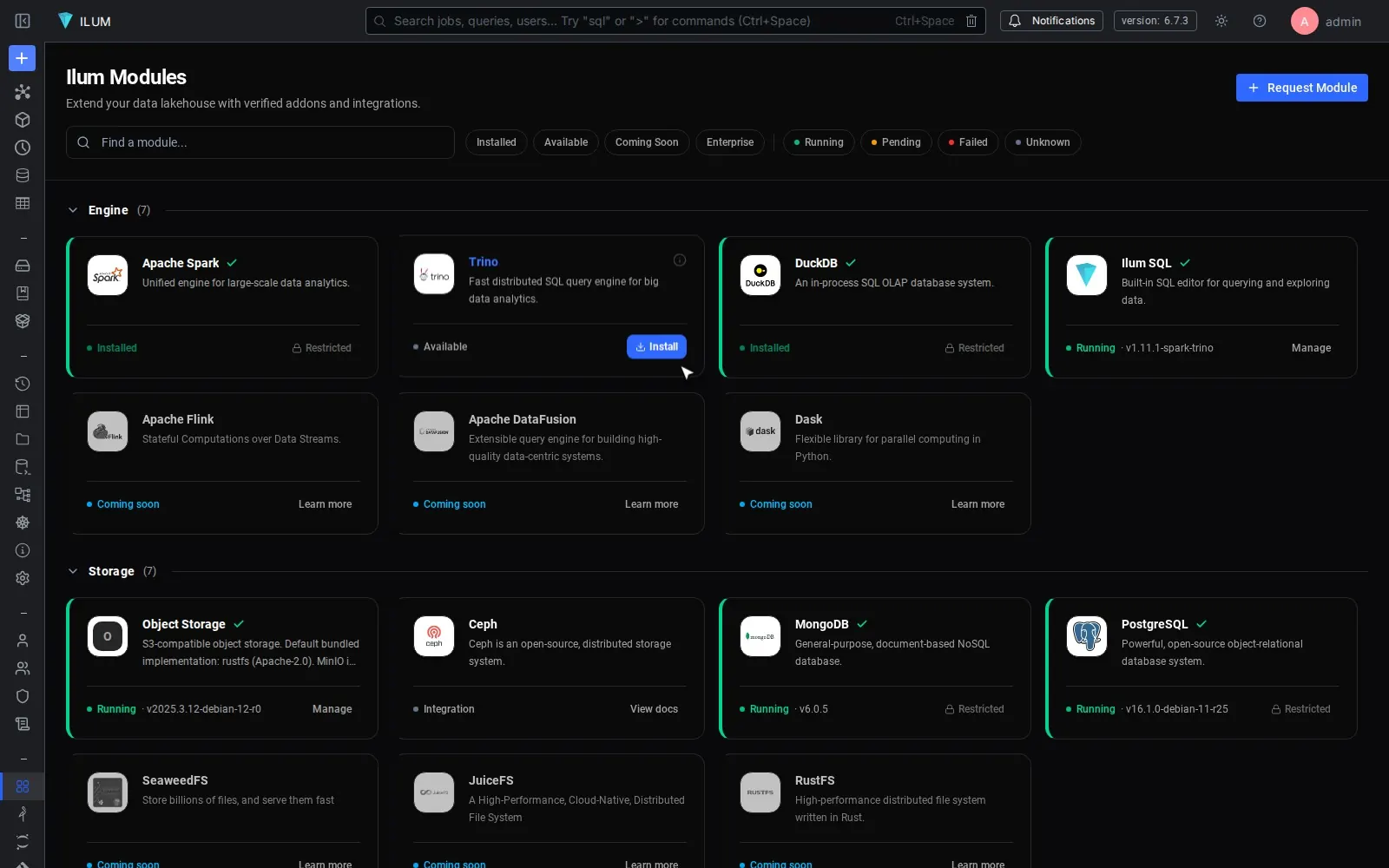
Which engines run Spark and SQL?
Every EMR option runs the same EMR runtime, in AWS’s words 100% API-compatible with the open-source frameworks. Ilum runs Apache Spark 4 and puts DuckDB and Trino beside Spark SQL, all over one catalog.
The EMR runtime for Apache Spark
The same performance-optimized runtime runs on EC2, on EKS and in EMR Serverless.
More engines on an EMR on EC2 cluster
A cluster can install Trino, Hive, Presto or HBase on the same nodes, and Spark shares them through YARN, the resource manager EMR uses by default.
Spark 4 on Kubernetes, with spark-submit
An Ilum job is a driver pod and executor pods on your cluster, and spark-submit works with ilum-core as its master.
Three SQL engines over one catalog
Spark SQL behind Apache Kyuubi, DuckDB inside ilum-core and Trino as a module (one statement on each).
The engines in detail
- Spark on EMR. The emr-spark-8.2.0 release for EKS carries Spark 4.1.3.
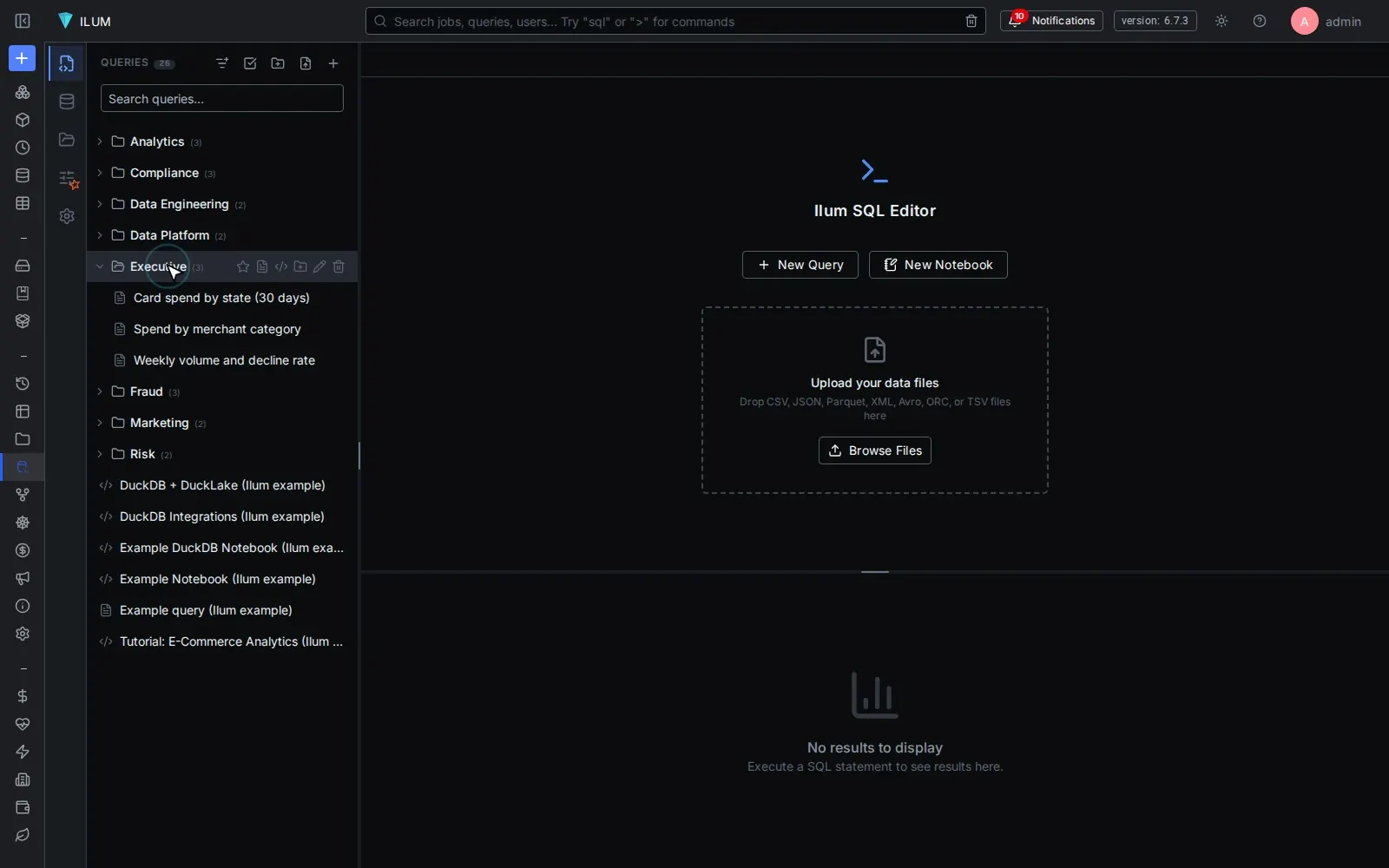
Where do tables live, and in which format?
On EMR the files stay in Amazon S3, and the AWS Glue Data Catalog of your account can be Spark’s metastore. Ilum reads and writes the same buckets, registers tables in its Hive Metastore and ships Spark images for Delta and Iceberg.
The Glue Data Catalog as metastore
Spark on EMR can use the AWS Glue Data Catalog as its Hive metastore and, from EMR 7.5.0, as its Iceberg REST catalog.
Iceberg, Delta Lake and Hudi on EMR
The latest EMR 7 release ships AWS builds of Iceberg, Delta Lake and Hudi, and EMR installs Hudi by default wherever Spark is installed.
Your S3 bucket, attached to Ilum once
Ilum takes S3, GCS, Azure and HDFS storage, and a bucket attached to a cluster once is open to every job.
Delta and Iceberg ready in Ilum
The chart ships a Spark image and catalog settings for Delta and another for Iceberg.
Tables in detail
- HDFS on EMR. HDFS on a cluster goes when the cluster does. Where a table lives in Ilum.
- Glue. Each account has one Data Catalog per Region.
- Your bucket. The Hive Metastore records where each table’s files are.
- Catalog modules. Project Nessie and Unity Catalog are catalog modules of Ilum.
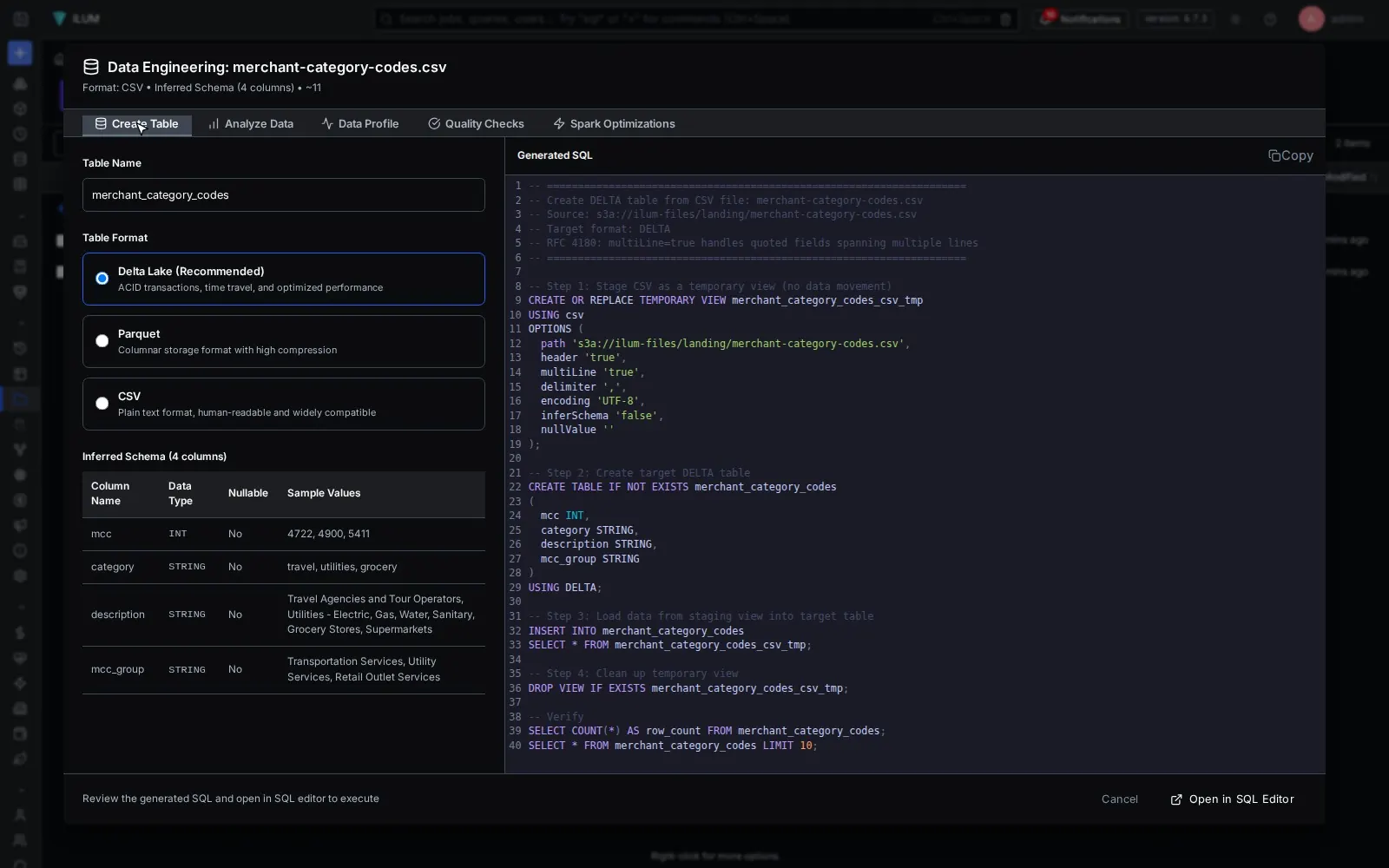
Notebooks, jobs and schedules
On EMR, work arrives as steps, job runs or notebooks in EMR Studio, and AWS points to Apache Airflow or Amazon MWAA for schedules. Ilum ships Jupyter on Spark, runs jobs, services and cron schedules, and installs Airflow and other orchestrators as modules.
Steps and job runs
An EMR on EC2 cluster runs ordered steps, and EMR on EKS and EMR Serverless take job runs through their APIs.
EMR Studio for notebooks
Studio Workspaces extend JupyterLab and run notebooks on EMR clusters, submit work to EMR on EKS as job runs, and save the work to an S3 location of the Studio.
Jupyter, jobs, services and schedules in Ilum
JupyterLab reaches Spark through Sparkmagic, and a schedule fires a job from a Kubernetes CronJob (how a schedule fires).
Airflow as a module of the release
Airflow, Kestra, Mage, n8n or NiFi install as modules, and Airflow’s LivyOperator submits Spark jobs to Ilum’s Livy proxy.
Notebooks and schedules in detail
- Steps and job runs. Up to 256 steps can be pending or running at a time, and a job run is, for example, a Spark JAR or a PySpark script.
- Jobs and services. In Ilum a job is one Spark application, and a service keeps Spark running between calls.
- Notebook modules. Zeppelin is a module of Ilum too, JupyterHub an Enterprise module.
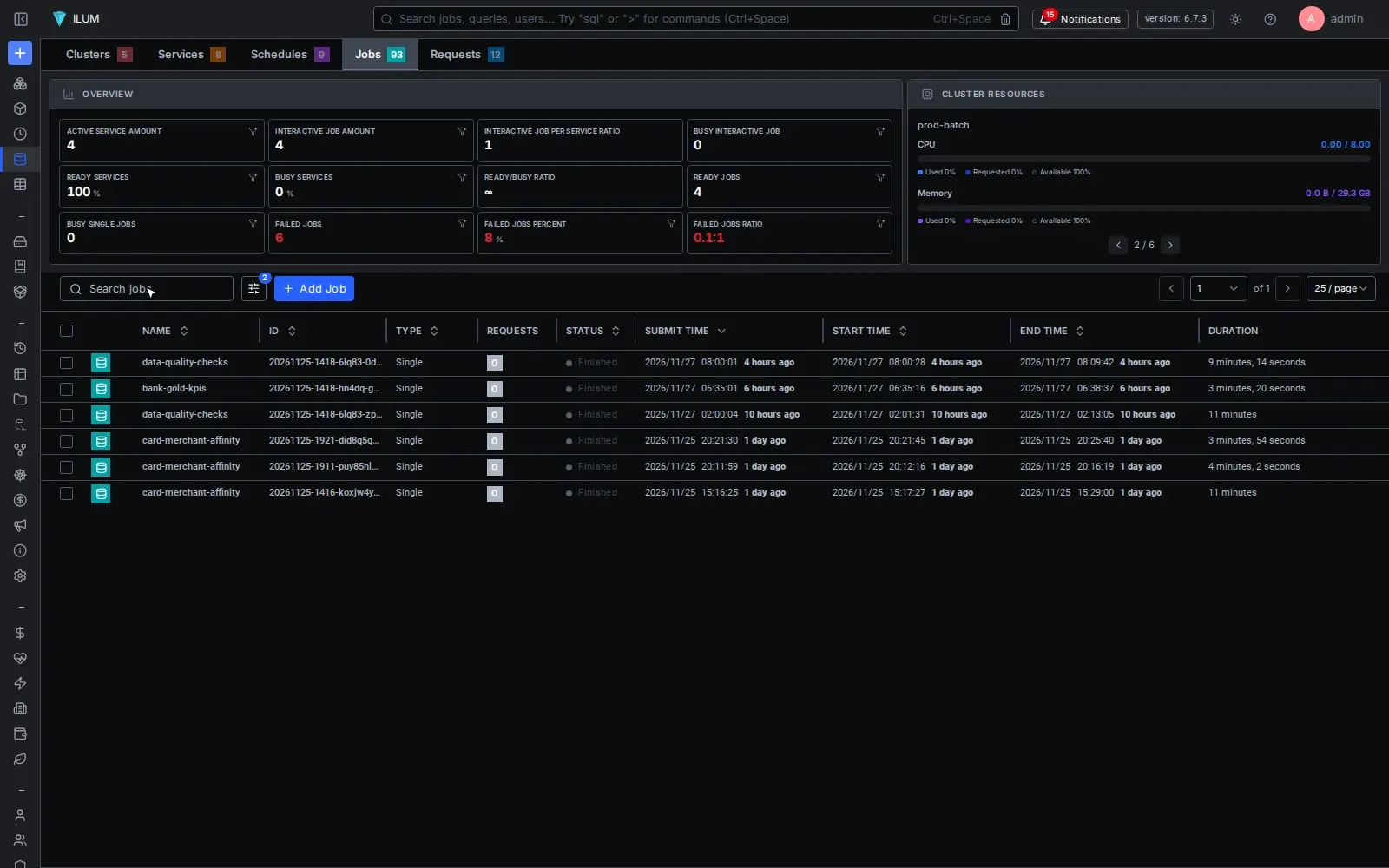
Access control, audit and lineage
EMR can scope each job with an IAM role, Lake Formation grants access to Glue tables down to cells, and CloudTrail records every EMR API call. Ilum has roles, LDAP or OAuth2 sign-in, an Event Log and column-level lineage from every Spark job.
An IAM role per job, and Lake Formation
EMR on EKS and EMR Serverless run every job with an IAM role you name, and on EC2 a runtime role can scope each step.
Lineage through SageMaker Unified Studio
EMR’s Spark has the OpenLineage libraries built in, and Spark settings send the events to Amazon SageMaker Unified Studio.
Four roles, LDAP and OAuth2 in Ilum Community
ADMIN, DATA_SCIENTIST, DATA_ENGINEER and USER are seeded on start, and sign-in can come from your directory or your OpenID Connect provider.
OpenLineage in every Spark job
Ilum adds the OpenLineage listener to every job and keeps what it sends in Marquez, in your cluster, down to single columns (follow one column).
Access and lineage in detail
- IAM on EC2. The runtime role takes the place of the instance profile the whole cluster shares. Lake Formation adds row, column and cell level access to Glue tables.
- Lineage on EMR. AWS lists its lineage as not automated by default.
- In Ilum. The Event Log names who did what, down to the API token. Apache Ranger is an Enterprise module.
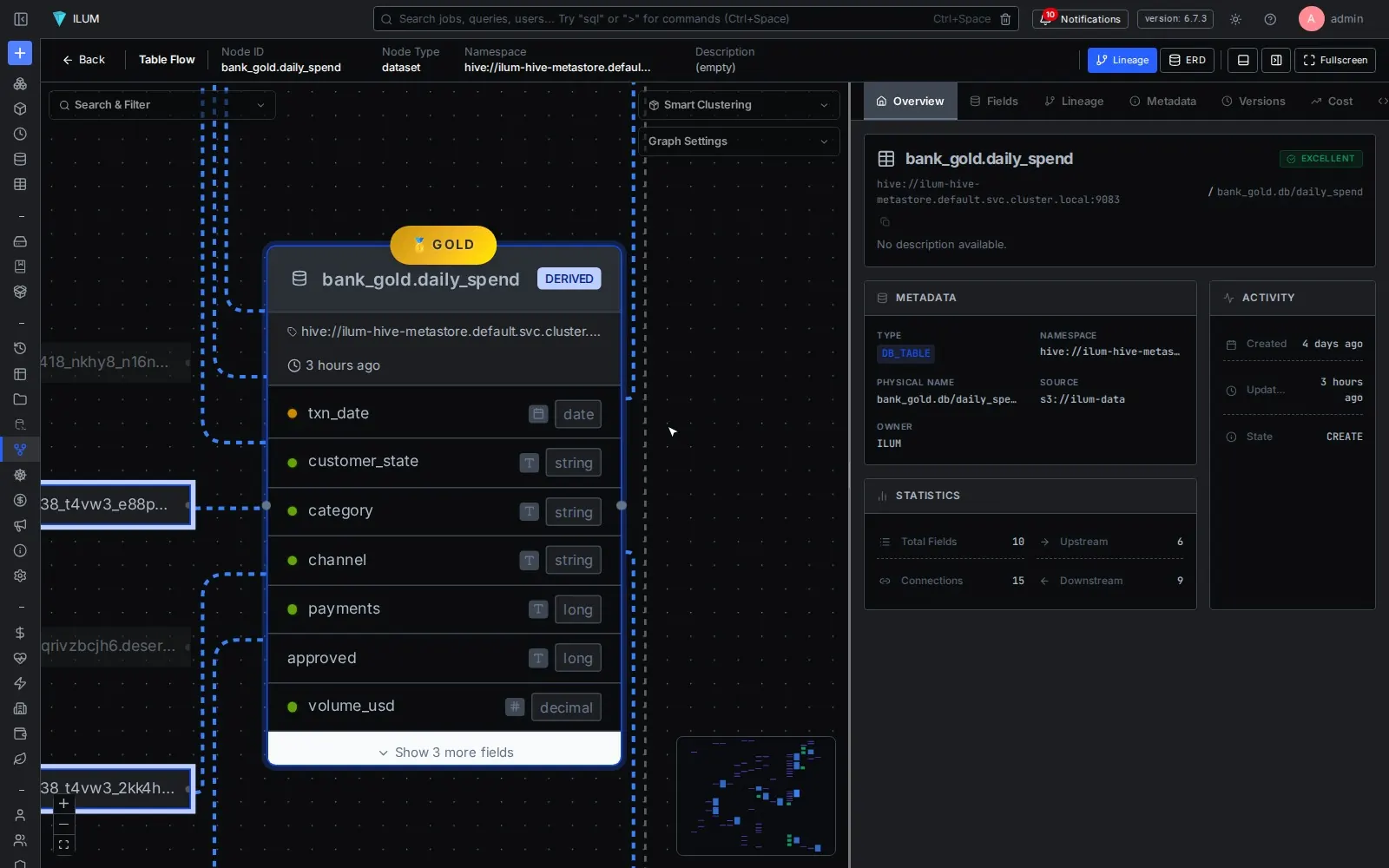
What does the same Spark work cost?
EMR adds its own price to the EC2 instances on EC2, and bills the vCPU and memory of its pods on EKS. Ilum Community has no platform fee, and its own services on your nodes are counted.
EMR on EC2: the EMR price on top of EC2
In AWS’s words, the Amazon EMR price is added to the EC2 price of the servers and to any EBS volumes.
EMR on EKS: the vCPU and memory of the pods
The fee runs from the start of the image download until the pod ends, for every pod on an image derived from the EMR runtime, whether the job came through StartJobRun, the Spark operator or spark-submit.
EMR Serverless: what the workers use
Serverless bills vCPU, memory and storage from when the workers are ready until they stop.
Ilum Community: no fee, and you run it
No platform fee, and your team runs Kubernetes and Ilum.
The cost in detail
- EMR on EKS. Its price comes on top of the EKS cluster and its nodes, and EMR on EC2 bills by the second.
- EMR Serverless. The cost calculator prices it beside the others.
- Running it. A managed service includes running the platform.
The same month on each, at list price
m6i.4xlarge nodes, 8 h a day, 30 days. List prices on 25 November 2026, us-east-1, on-demand. USD a month.
ComputePlatform feeControl planeIlum’s own services
Compute only: storage, data transfer and support are not in these numbers.
What moves over, and what stays behind?
Spark code moves as it is, and the files stay in your S3 buckets. What is written against EMR’s own APIs changes: steps and job runs become Ilum jobs, and Glue tables are registered again over the same files.
spark-submit works against Ilum
A Spark job in Ilum runs like one submitted with the standard spark-submit: point --master at ilum-core and keep your JAR or Python file.
Steps and job runs become Ilum jobs
A job run’s entry point and Spark parameters carry over, and the call that submits it changes to spark-submit, the Ilum console or Airflow’s LivyOperator.
The data stays, the catalog moves
Ilum’s Hive Metastore records each table’s schema and where its files are, on S3 or elsewhere, so a table of the Glue Data Catalog is registered in it again over the same files.
Notebooks from EMR Studio
Ilum’s JupyterLab opens Jupyter notebooks from EMR Studio, has Git built in and reaches Spark through Sparkmagic.
What moves, in detail
- EMR on EKS. It accepts spark-submit as well.
- Steps and job runs. Both go through EMR’s API, and an entry point is a JAR or Python file.
- EMR Studio. It keeps Jupyter notebooks in an S3 location of the Studio or a linked Git repository.
./bin/spark-submit \
  --master k8s://http://<ilum-core-address>:<ilum-core-port>  \
  --deploy-mode cluster \
  --class org.apache.spark.examples.SparkPi \
  --conf spark.ilum.cluster=default \
  --conf spark.kubernetes.container.image=ilum/spark:4.1.2 \
s3a://ilum-files/ilum/default/spark-examples_2.13-4.1.2.jarilum_livy_jar_with_http_resource = LivyOperator(
task_id='ilum_livy_jar_with_http_resource',
file='https://ilum.cloud/release/latest/spark-examples_2.13-4.1.1.jar',
num_executors=1,
conf={
'spark.shuffle.compress': 'false',
},
class_name='org.apache.spark.examples.SparkPi',
args=[5],
polling_interval=5,
livy_conn_id='ilum-livy-proxy'
)Amazon Web Services, AWS, Amazon EMR, Amazon EC2, Amazon EKS, Amazon S3, AWS Glue, AWS Lake Formation, AWS CloudTrail, Amazon SageMaker, AWS Fargate, Apache Spark and Delta Lake are trademarks of their owners. They are named here only to compare the products, from the owners’ public pages. Ilum is not affiliated with or endorsed by any of them.
Questions and answers
Is Ilum an alternative to Amazon EMR?
For Spark jobs, SQL, notebooks, scheduling, a catalog and lineage, yes: Ilum runs them on a Kubernetes cluster you operate, EKS included. Amazon EMR is a managed service of AWS. Choose EMR to have AWS run Spark for you, and Ilum when the whole platform has to run on infrastructure you control, on EKS or anywhere else. What teams build on Ilum, sector by sector, is on data platform use cases by industry.
What is the difference between EMR on EC2, EMR on EKS and EMR Serverless?
EMR on EC2 provisions a cluster of EC2 instances in your account and installs the applications you choose. EMR on EKS runs each Spark job as pods in a namespace of an EKS cluster you run. EMR Serverless runs jobs on workers it provisions and releases, with no cluster to configure or operate.
How is Ilum different from EMR on EKS?
Both run Spark as pods on Kubernetes. With EMR on EKS the cluster and its nodes are yours, AWS runs the service that takes job runs and keeps their Spark history, and AWS bills the vCPU and memory of every pod on an EMR runtime image. With Ilum the console, the job service, the history server, the catalog and lineage are pods of one Helm release in your cluster too, with no platform fee.
Can I run Spark on Kubernetes instead of EMR?
Yes. Ilum runs Spark on any CNCF Kubernetes, EKS among them: spark-submit takes ilum-core as its master, and each job is a driver pod with executor pods in your cluster. Data in S3 stays where it is and is attached to Ilum once.
Can Ilum use my data in S3 and my Glue tables?
Ilum reads and writes S3, GCS, Azure and HDFS storage, open to every job once attached to a cluster. Its catalog is the Hive Metastore of the release, which records where each table’s files are, so tables of the AWS Glue Data Catalog are registered in it again over the same files.
Is Ilum open source?
No. Ilum Community runs on a free-tier license key, and it is built on open-source engines: Apache Spark, Trino, DuckDB, Apache Kyuubi, the Hive Metastore and Marquez.
How do the costs of Ilum and EMR compare?
EMR on EC2 adds a per-second EMR price to the EC2 instances, EMR on EKS bills the vCPU and memory of its pods on top of EKS, and EMR Serverless bills the vCPU, memory and storage of its workers. Ilum Community has no platform fee: you pay for the nodes, and you run Kubernetes and Ilum yourself. The cost calculator prices the same Spark work on each at list price, with the arithmetic.
Do I need Kubernetes to run Ilum?
Yes. Ilum deploys only on Kubernetes, with Helm, and any CNCF-compliant distribution works: EKS, GKE, AKS, OpenShift, Rancher or bare metal.
Contact
Tell us about your cluster.
Name one workload you want to move.
Tell us where it runs today.
We answer with a plan, not a deck.
We reply within two working days.