
Compare
Ilum vs Databricks: a self-hosted alternative on your Kubernetes.
Databricks is a managed service, with its control plane in Databricks’ account and the compute in your AWS account or, serverless, in its own. Ilum Community runs every part on a Kubernetes cluster you operate, with no platform fee.
Same nodes. Same month.
50 m6i.4xlarge nodes, 8 h a day, 30 days. List prices on 25 November 2026, us-east-1, on-demand. USD a month.
Databricks on AWSJobs Compute, Premium
14,688.00
Ilum Communityon EKS, no platform fee
9,621.72
EC2 nodesDBUsEKS clusterIlum’s own services
Where does each part run?
Pick a way to run the platform. Each part moves to the account it runs in and says who runs it.
Nothing of Ilum runs here.
Console and backend services
Databricks runs itYours to runDatabricks’ accountYour Kubernetes cluster
The web application and the backend services Databricks manages: the control plane, in Databricks’ account.
The console, the REST API and the module manager are pods of one Helm release in your cluster.
ilum-uiilum-coreilum-apiSpark and SQL compute
Databricks runs itYours to runYour AWS accountDatabricks’ accountYour Kubernetes cluster
Clusters and pro or classic SQL warehouses run in your account, in the workspace’s network. Databricks launches them there.
Serverless compute runs in Databricks’ account, and Databricks allocates and manages it.
Every workload runs on serverless compute in Databricks’ account.
Spark drivers and executors are pods in your cluster. Spark SQL runs behind Kyuubi, DuckDB inside ilum-core, Trino as a module.
ilum-sqlilum-trinoRun results and workspace data
Yours to runDatabricks runs itYour AWS accountDatabricks’ accountYour Kubernetes cluster
Job run results, SQL query results and notebook revisions go to the workspace storage bucket, an S3 bucket you provide.
Workspace data goes to default storage, a fully managed storage location in Databricks’ account.
The platform’s metadata is kept in the PostgreSQL of the release, in your cluster.
ilum-postgresqlTable files
Yours to runDatabricks runs itYour AWS accountDatabricks’ accountYour Kubernetes cluster
Managed tables go to an S3 bucket you create in your own account, registered in Unity Catalog.
The default catalog is in default storage too. A cloud storage location of yours can be connected for other tables.
Files go to the MinIO of the release or to storage of yours on S3, GCS, Azure or HDFS. The Hive Metastore of the release registers them.
ilum-minioilum-hive-metastore
What crosses between the two
The clusters in your network reach the control plane through a secure tunnel over HTTPS on port 443. Your network has no open ports, and the nodes have no public IP addresses.
Serverless compute in Databricks’ account reaches your buckets through S3 gateway endpoints, private IPs or public IPs, set with network connectivity configurations.
Serverless compute and default storage are not deployed in your cloud account. Storage of yours is reached once you connect it.
The parts call each other inside your cluster, and Ilum runs no service outside it. ilum-core checks the signature of its license key in your cluster.
Who bills you
Databricks bills DBUs. AWS bills the virtual machines, disks and network in your account.
Databricks bills DBUs, and for serverless the DBU price already includes the virtual machines.
No platform fee: Community runs on a free-tier license key. You pay for the nodes, to your cloud or for your own servers.
Who operates the platform?
Databricks manages its control plane, and with serverless the compute too. Ilum Community is software you install with Helm and then run: its upgrades, its capacity and the cluster under it are yours.
Databricks runs the control plane
The web application and the backend services are in Databricks’ account, managed by Databricks, whichever compute you pick.
Classic clusters run in your account, launched by Databricks
A credential configuration gives Databricks access to launch compute resources in your AWS account.
Ilum runs on any CNCF Kubernetes
EKS, GKE, AKS, OpenShift, Rancher or bare metal, in a cloud account or your own data center.
Modules install from the console
ilum-api installs, upgrades and disables optional modules at runtime through Helm, so Trino or Airflow is one press of Install (how a module installs).
Operations in detail
- One release. One Helm release holds every part. Data sovereignty on infrastructure you operate.
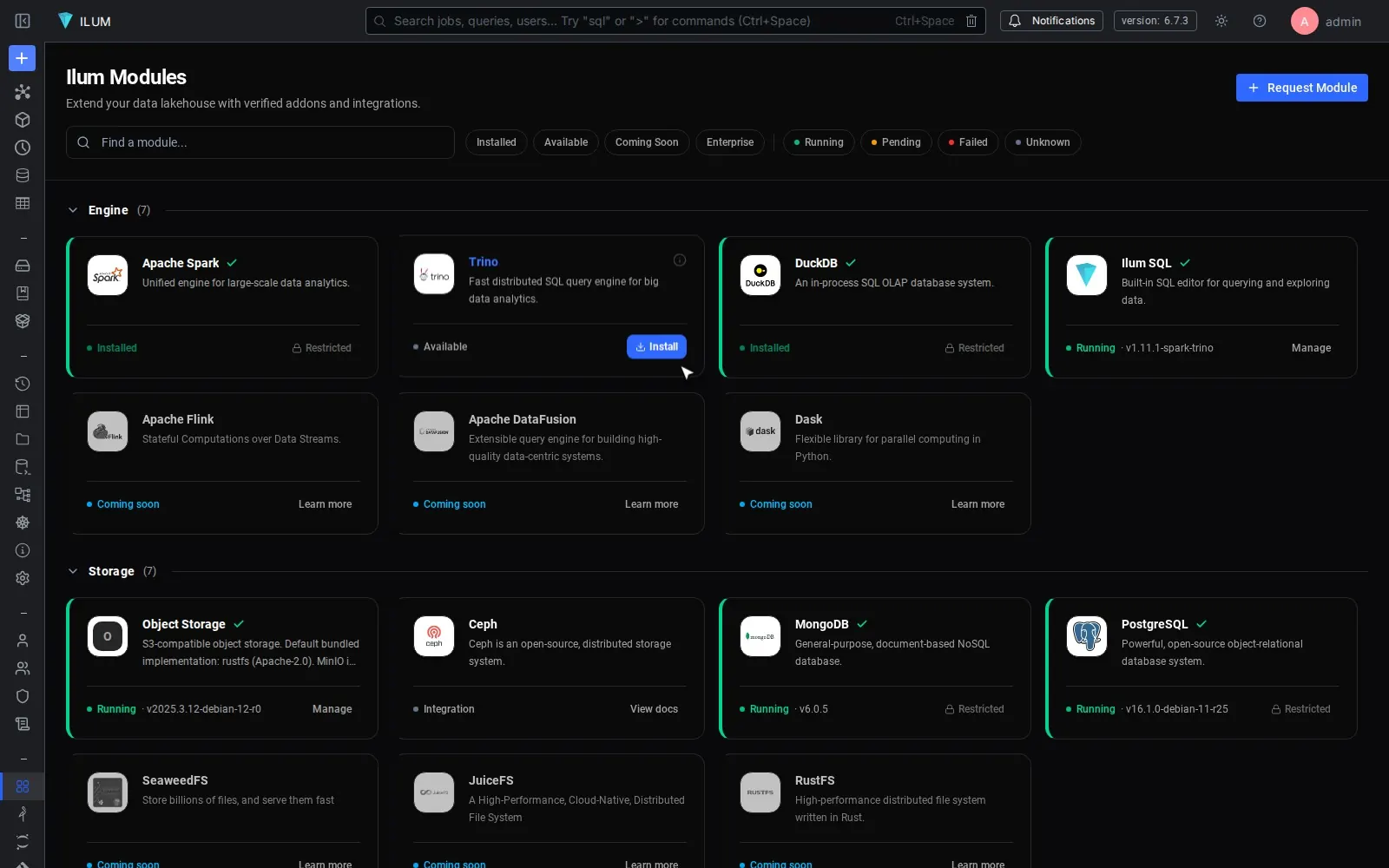
Which engines run Spark and SQL?
Databricks pairs the Apache Spark APIs with Photon, its own vectorized engine, the default for every SQL warehouse. Ilum runs Apache Spark 4 and puts DuckDB and Trino beside Spark SQL, all over one catalog.
Photon, the Databricks-native engine
Databricks says Photon is compatible with Apache Spark APIs, so existing code works with no changes.
SQL warehouses: serverless, pro or classic
A pro or classic warehouse keeps its compute layer in your AWS account, and serverless compute runs in Databricks’ account.
Spark 4 on Kubernetes, with spark-submit
An Ilum job is a driver pod and executor pods on your cluster, and spark-submit works with ilum-core as its master.
Three SQL engines over one catalog
Spark SQL behind Apache Kyuubi, DuckDB inside ilum-core and Trino as a module (one statement on each).
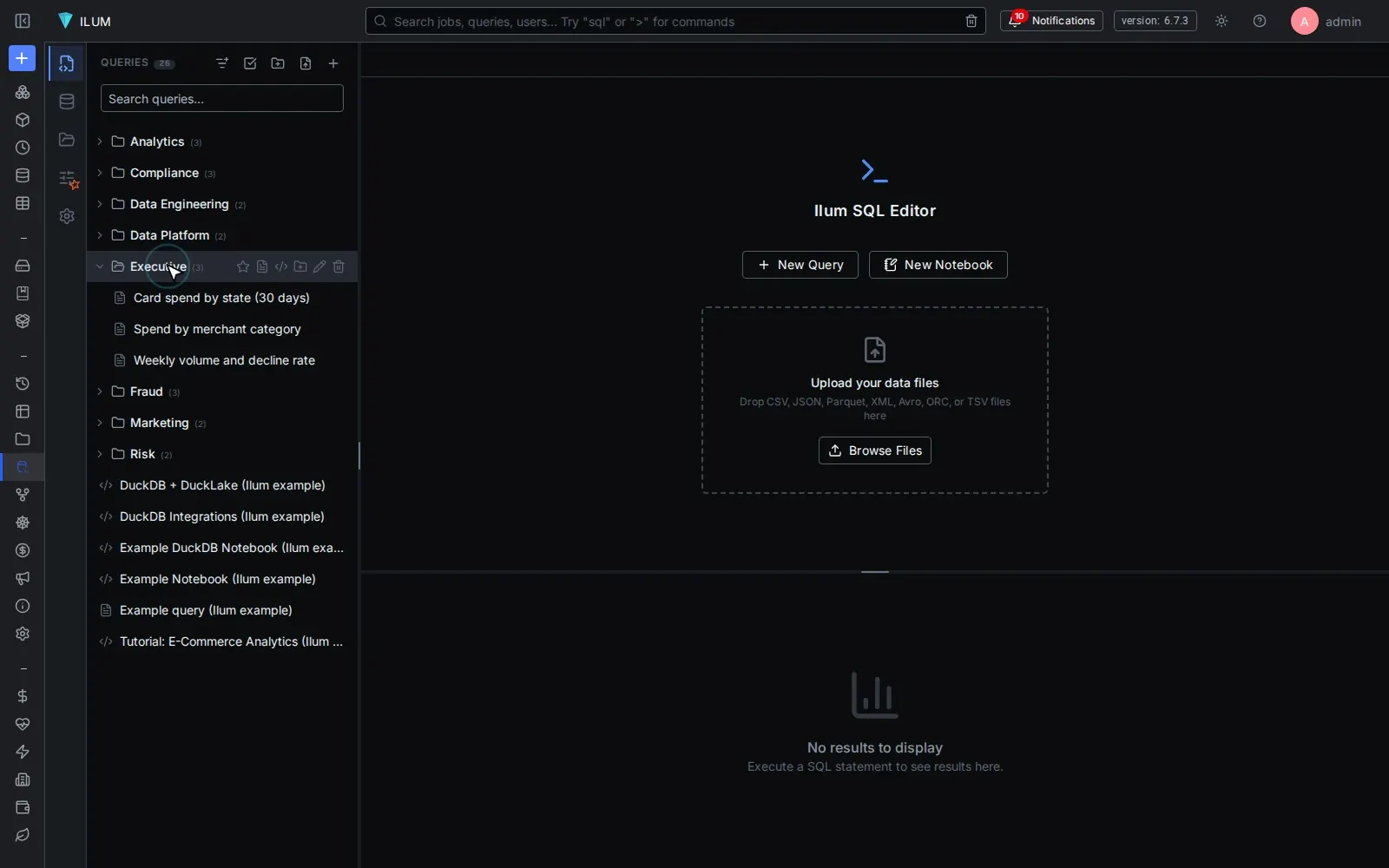
Where do tables live, and in which format?
On Databricks a table is Delta Lake unless you say otherwise, and Unity Catalog creates Iceberg tables too. Ilum keeps tables in your bucket, registered in the Hive Metastore, with Delta and Iceberg ready and Unity Catalog OSS as a module.
Delta Lake by default on Databricks
Delta Lake is the default format for all operations on Databricks, and Delta Lake itself is open source.
Iceberg through Unity Catalog
Iceberg tables created in Unity Catalog are managed Iceberg tables, and its Iceberg REST Catalog API lets external Iceberg engines read and write them.
Delta and Iceberg ready in Ilum
The chart ships a Spark image and catalog settings for Delta and another for Iceberg.
Unity Catalog OSS as Ilum’s catalog
Three Helm values make Unity Catalog OSS Ilum’s catalog in place of the Hive Metastore.
Tables in detail
- Formats. A table names its format when it is written. Where a table lives in Ilum.
- Unity Catalog OSS. Its docs advise S3, GCS or ADLS for it, as it does not yet work with the bundled MinIO.
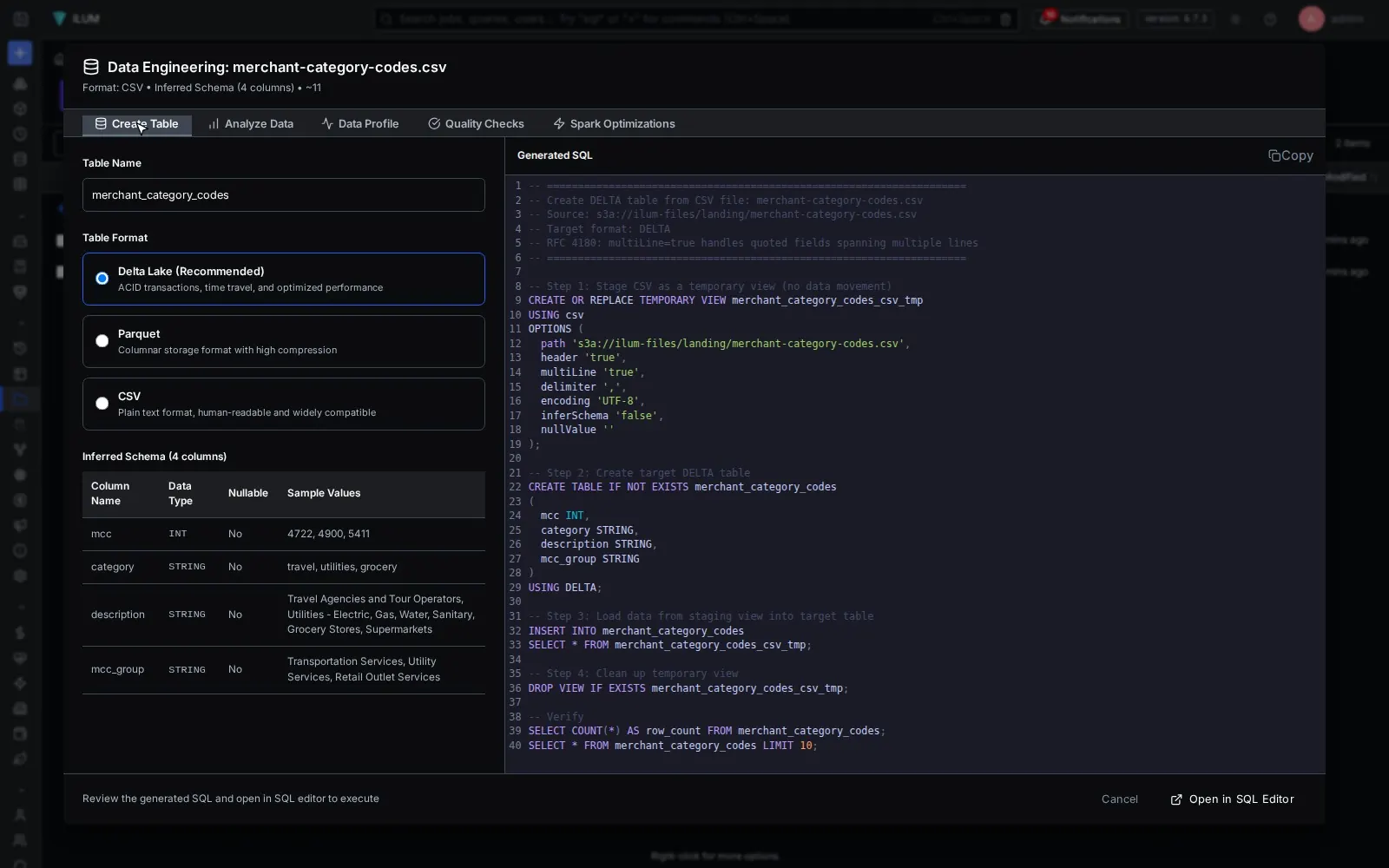
Notebooks, jobs and schedules
Databricks notebooks take Python, SQL, Scala and R with real-time coauthoring, and Lakeflow Jobs orchestrates them. Ilum ships Jupyter on Spark, runs jobs, services and cron schedules, and installs Airflow and other orchestrators as modules.
Lakeflow Jobs runs Databricks tasks
A job runs tasks such as notebooks, pipelines and Python scripts, and a trigger starts it at a scheduled time or on an event.
Jupyter on Spark in every Ilum install
Ilum’s JupyterLab reaches Spark through Sparkmagic, so a cell runs on the cluster (how a cell reaches Spark).
Jobs, services and cron schedules
A job is one Spark application, a service keeps Spark running between calls, and a schedule fires a job from a Kubernetes CronJob (how a schedule fires).
Airflow, Kestra, Mage, n8n or NiFi
Each orchestrator is a module of the same Helm release, switched on from the console or with one value.
Notebooks and schedules in detail
- Notebook modules. Zeppelin is a module, JupyterHub an Enterprise module.
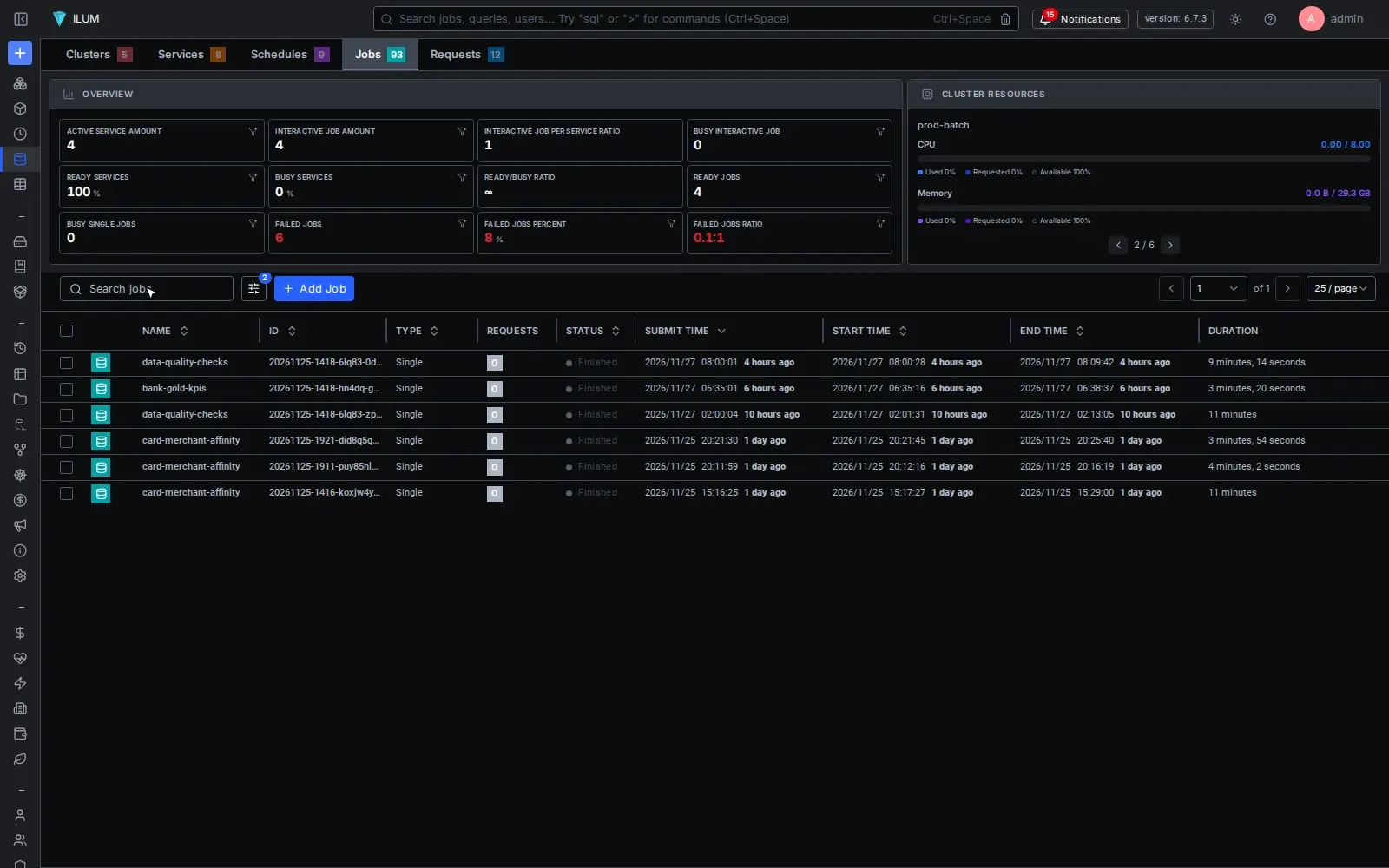
Access control, audit and lineage
Unity Catalog governs access with privileges, attribute-based policies and row and column filters, and keeps an audit log and column lineage. Ilum has roles, LDAP or OAuth2 sign-in, an Event Log and column-level lineage from every Spark job.
Unity Catalog: privileges, policies and filters
Databricks manages who can access what with privileges, attribute-based policies, row and column filters and workspace bindings, and records data access in the audit log system table.
Lineage of tables registered in Unity Catalog
Databricks captures lineage automatically for queries run on Databricks, down to the column level, for tables registered in a Unity Catalog metastore.
Four roles, LDAP and OAuth2 in Ilum Community
ADMIN, DATA_SCIENTIST, DATA_ENGINEER and USER are seeded on start, and sign-in can come from your directory or your OpenID Connect provider.
OpenLineage in every Spark job
Ilum adds the OpenLineage listener to every job and keeps what it sends in Marquez, down to single columns (follow one column).
Access and lineage in detail
- In Ilum. The Event Log names who did what, down to the API token. Apache Ranger is an Enterprise module.
What does the same Spark work cost?
Databricks bills DBUs on top of the cloud’s virtual machines for classic compute, and DBUs that already include them for serverless. Ilum Community has no platform fee, and its own services on your nodes are counted.
DBUs per node-hour, by instance type
Databricks’ price feed lists the DBUs an hour of each instance type and a price per DBU for each tier.
Classic compute: two bills
In Databricks’ words, total costs include DBUs plus virtual machine, disk and associated network costs.
Ilum Community: no fee, and you run it
No platform fee, and your team runs Kubernetes and Ilum.
The cost in detail
- DBU. Databricks describes a DBU as a normalized unit of processing power.
- Running it. A managed service includes running the platform.
The same month on both, at list price
m6i.4xlarge nodes, 8 h a day, 30 days. List prices on 25 November 2026, us-east-1, on-demand. USD a month.
ComputePlatform feeControl planeIlum’s own services
Compute only: storage, data transfer and support are not in these numbers.
What moves over, and what stays behind?
Spark code moves as it is: Ilum takes the same spark-submit, and Delta and Iceberg are open formats its Spark reads and writes. What was written for Databricks alone, such as dbutils, needs rewriting.
spark-submit works against Ilum
A Spark job in Ilum runs like one submitted with the standard spark-submit: point --master at ilum-core and keep your JAR or Python file.
Notebooks leave as .ipynb
Databricks exports a notebook as an IPython notebook, a Jupyter file with the extension .ipynb, which Ilum’s JupyterLab opens.
Code that calls dbutils needs changes
Databricks’ reference says an application that uses dbutils must be deployed in Databricks to run, so replace those calls with Spark and Python before moving it.
Open formats, and an open catalog
Delta Lake is open source, and Unity Catalog has an open-source implementation, which Ilum can run as its catalog.
What moves, in detail
- Notebooks. Notebooks leave Databricks as Jupyter files.
./bin/spark-submit \
  --master k8s://http://<ilum-core-address>:<ilum-core-port>  \
  --deploy-mode cluster \
  --class org.apache.spark.examples.SparkPi \
  --conf spark.ilum.cluster=default \
  --conf spark.kubernetes.container.image=ilum/spark:4.1.2 \
s3a://ilum-files/ilum/default/spark-examples_2.13-4.1.2.jarhelm upgrade \
--set ilum-core.metastore.enabled=true \
--set ilum-core.metastore.type="unity" \
--set ilum-unity-catalog.enabled=true \
--reuse-values ilum ilum/ilumDatabricks, Photon, Unity Catalog, Lakeflow, Delta Lake, Amazon Web Services and AWS are trademarks of their owners. They are named here only to compare the products, from the owners’ public pages. Ilum is not affiliated with or endorsed by any of them.
Questions and answers
Is Ilum an alternative to Databricks?
For Spark jobs, SQL, notebooks, scheduling, a catalog and lineage, yes: Ilum runs them on a Kubernetes cluster you operate. Databricks is a managed service with its control plane in Databricks’ account. Choose Databricks to have the platform run for you, and Ilum when every part has to run on infrastructure you control. What teams build on Ilum, sector by sector, is on data platform use cases by industry.
Where does Databricks store my data?
In a classic workspace, the workspace storage bucket and the bucket of managed tables are S3 buckets in your AWS account, and the control plane is in Databricks’ account. A serverless workspace keeps its data in default storage in its Databricks account, and can connect storage of yours.
Is Ilum open source?
No. Ilum Community runs on a free-tier license key, and it is built on open-source engines: Apache Spark, Trino, DuckDB, Apache Kyuubi, the Hive Metastore and Marquez.
Can Ilum read Delta Lake tables and use Unity Catalog?
Yes. The chart ships Spark images and catalog settings for Delta and for Iceberg, and three Helm values make Unity Catalog OSS Ilum’s catalog in place of the Hive Metastore. With Unity Catalog as the catalog, keep the tables on S3, GCS or ADLS rather than the bundled MinIO.
Can I run my Databricks notebooks on Ilum?
Export them as IPython notebooks, .ipynb files, and open them in Ilum’s JupyterLab, where cells run on Spark through Sparkmagic. Code that calls dbutils is written for Databricks, whose reference says such an application must be deployed in Databricks to run, so replace those calls first.
How do the costs of Ilum and Databricks compare?
Databricks bills DBUs on top of the virtual machines for classic compute, and DBUs that include them for serverless. Ilum Community has no platform fee: you pay for the nodes, and you run Kubernetes and Ilum yourself. The cost calculator prices the same Spark work on both at list price, with the arithmetic.
Do I need Kubernetes to run Ilum?
Yes. Ilum deploys only on Kubernetes, with Helm, and any CNCF-compliant distribution works: EKS, GKE, AKS, OpenShift, Rancher or bare metal.
Contact
Tell us about your cluster.
Name one workload you want to move.
Tell us where it runs today.
We answer with a plan, not a deck.
We reply within two working days.