
Compare
Leave Cloudera in one weekend: Bifrost and Ilum.
Bifrost moves a CDP or CDH cluster to open-source Hadoop in one planned weekend, proven in production on clusters of more than 200 nodes. Two to four weeks of preparation on the cluster you operate come first, and you can go back until you finalize.
200+ nodes. One weekend.
The largest production cutover, stop-and-swap, run from Heimdall
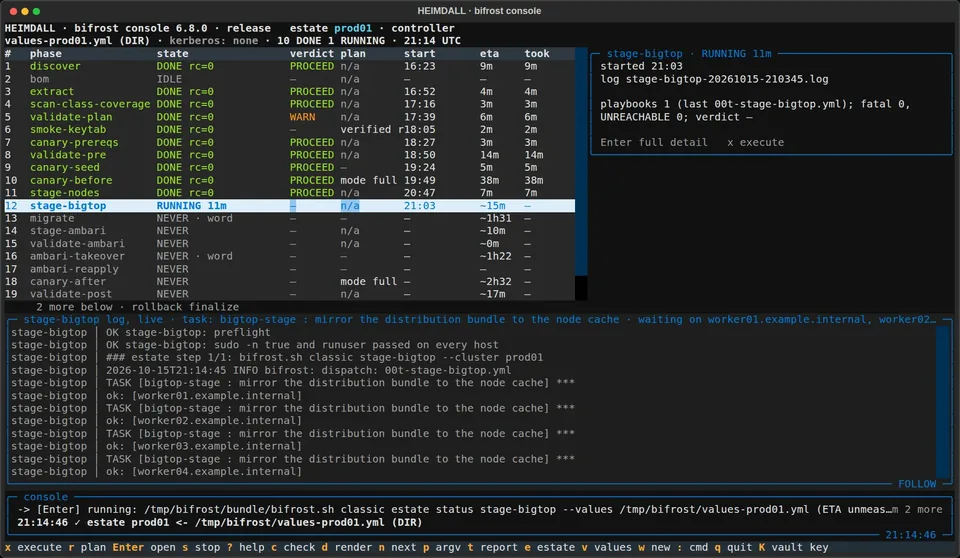
Same hosts. Same data. Same jobs.
A Classic weekend replaces the distribution, the management console and the license. The hosts, the data and the jobs your teams run stay as they are.
3 of 7 layers change over the weekend.
Cloudera on cloud runs its Management Console in Cloudera’s control plane, and Ilum on Kubernetes runs every part on a cluster you operate.
- LicenseCloudera subscriptionNonewas Cloudera subscriptionreplaced
- Management consoleCloudera ManagerApache Ambari (Ilum build)was Cloudera Managerreplaced
- PackagesCloudera parcelsIlum Bigtop RPMswas Cloudera parcelsreplaced
- Catalog and securityHive Metastore, Ranger, Atlas and Kerberossame
- JobsSpark 2 and 3, Hive, Impala, Oozie and Huesame
- DataHDFS on the disks of your hostssame
- HostsYour hosts, their hostnames and portssame
What happens to the cluster over the weekend?
Bifrost backs up the cluster, stops it and swaps the Cloudera distribution for open-source Hadoop on the same hosts, with abort gates through the night. The Cloudera migration weekend, hour by hour, shows what runs at each moment and the way back from it.
- Sat 20:00The window opens
- About 00:00Services start
- Sun 04:00NameNode active
- Sun 06:00Safe mode exited
- Sun 10:00Every DataNode reports
- Sun 18:00Full validation passes
- MondayIn production, rollback open
Classic, Modernize or Direct: which path fits?
Classic ends Cloudera licensing in place: two to four weeks of preparation, then one weekend cutover. Modernize and Direct move to Ilum on Kubernetes over two to five months.
Classic: CDP 7 and CDH 6, in place
For when the license is the priority and Kubernetes is not on the table yet.
Modernize: to Ilum on Kubernetes, table by table
Each Hive table becomes Iceberg first, and a table that fails validation reverts in microseconds.
Direct: CDP to Kubernetes in one program
For CDP estates that are mostly Spark, and its last, irreversible step ends the Cloudera subscription requirement.
Leave first, modernize later
Classic followed by Modernize is a supported sequence, and its end state equals Direct.
The paths in detail
- Classic. Proven in production on clusters of more than 200 nodes, cut over in one weekend from the Heimdall console. Preparation before the window takes at least two to four weeks.
- Modernize. Trino keeps queries working while storage moves.
- Direct. Its last step shuts Cloudera Manager down.
- Which one fits your estate is the subject of Cloudera and Hadoop migration.
ClassicCDP 7 or CDH 6 to open-source Hadoop, on the same hosts
2 to 4 weeks of preparation on the live cluster, one weekend, a 5-day soakWay back until finalize
ModernizeOpen-source Hadoop to Ilum on Kubernetes, table by table
2 to 5 monthsEach table can revert
DirectCDP to Ilum on Kubernetes in one program
2 to 5 monthsThe last step is irreversible
Classic followed by Modernize ends where Direct does. Which path fits your estate: Cloudera and Hadoop migration.
What happens to HDFS, Hive, Oozie and the rest?
Over the weekend every component stays what it is, now on open-source packages. Modernize and Direct then replace them one by one.
Hive keeps its metastore
Classic re-points the metastore database in place, and on CDH 6 upgrades its schema to Hive 3.
Oozie stays, then becomes Airflow
Classic keeps Oozie, and Modernize converts its workflows to Airflow 3 DAGs with dbt.
Kerberos, TLS and Ranger as they are
Keytabs are copied, never regenerated, certificates reused and principals kept.
What stays manual
Custom UDFs, HBase coprocessors and Pig scripts get annotated stubs, and their rewrite is yours, as are changes to application code.
The components in detail
- The weekend carries every component as it is, from HDFS and Hive to Kafka, Hue and Oozie, and Bifrost states how much of each later move it automates.
- Oozie. Classic carries its share library. Bundles are not converted automatically and need hands.
- Sentry. On CDH 6, Sentry roles become Ranger policies.
| Component | After the weekend | On Kubernetes | Automated |
|---|---|---|---|
| HDFS | In place, data untouched | S3A object storage | 85-97% |
| YARN | In place, queues carried | Spark Operator and YuniKorn | 95% |
| Hive Metastore | Same database, re-pointed | Iceberg REST catalog | 70-90% |
| Hive and Impala | Carried, Impala under Ranger | Trino | 75-85% |
| Oozie | Carried with its share library | Airflow 3 with dbt | 40-55% |
| Ranger | Policies carried and compared | Open Policy Agent | 60-70% |
| Atlas | Rebuilt, hooks carried | OpenMetadata | 60-75% |
| HBase | Kept on HDFS | Cassandra, ScyllaDB or Bigtable | 40-55% |
| Livy | Carried for each Spark line | Ilum’s Livy-compatible proxy | 99% |
Automated: the upper bound of the mechanical work Bifrost does for each move to Kubernetes. Map your own estate on the Hadoop migration page.
Which engines run Spark and SQL?
Cloudera Runtime ships Spark, Hive on Tez and Impala over the Hive Metastore. Ilum runs Spark 4 on Kubernetes, with Spark SQL, Trino and DuckDB over one catalog.
Impala and Hive in Cloudera Runtime
After the weekend, Impala and both Spark lines run on the same hosts.
Spark 4 on Kubernetes, with spark-submit
An Ilum job is a driver pod and executor pods on your cluster, and spark-submit works with ilum-core as its master.
Three SQL engines over one catalog
Spark SQL behind Apache Kyuubi, DuckDB inside ilum-core and Trino as a module (one statement on each).
Livy clients keep working
Ilum answers Livy calls through its own proxy, so job-submission clients keep working while workloads move to Kubernetes.
The engines in detail
- Impala. Cloudera’s low-latency SQL engine spreads each query over its nodes, which run the fragments in parallel, with the Hive Metastore as its catalog.
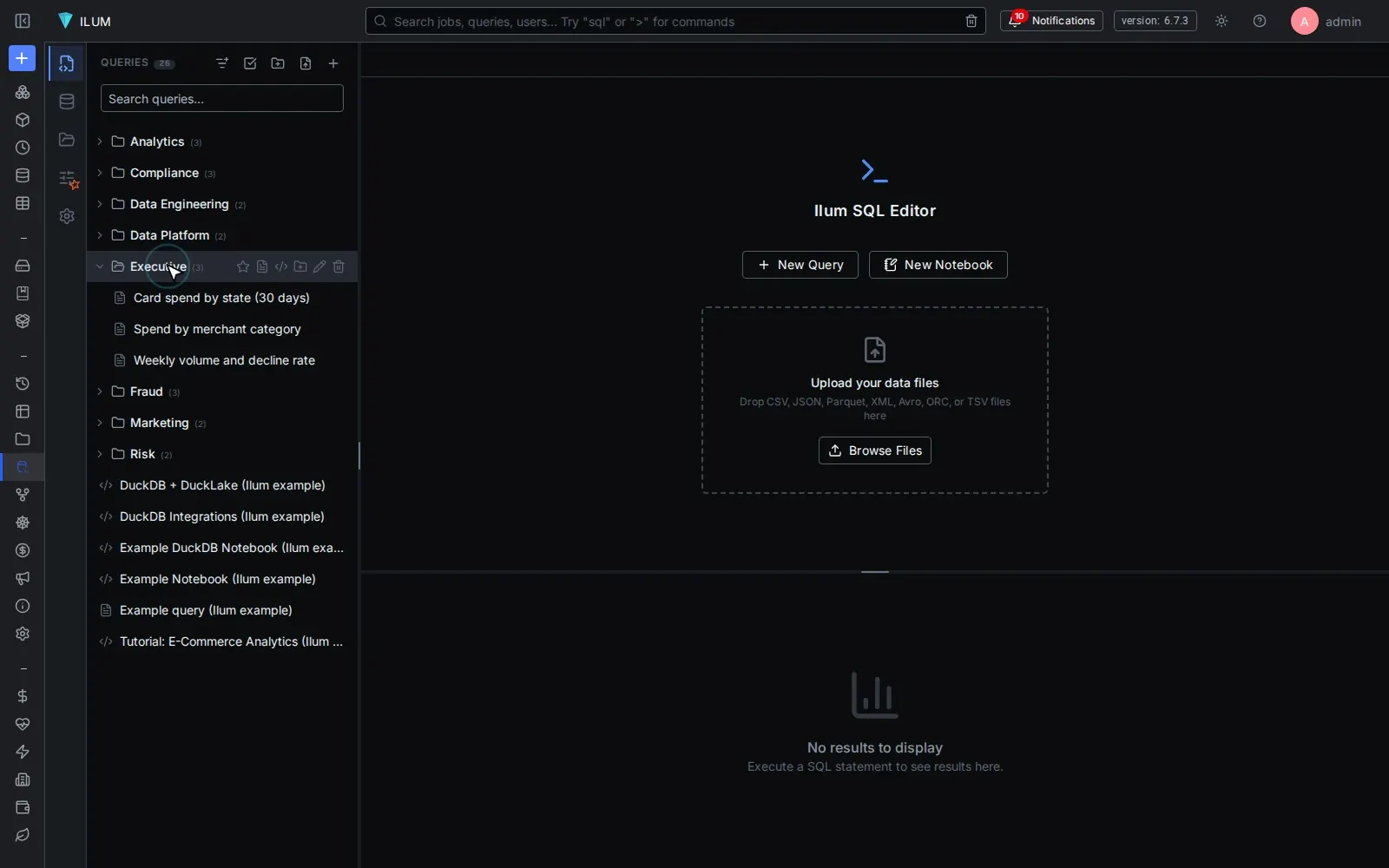
Where do tables live, and in which format?
On Cloudera, the Hive Metastore registers tables in HDFS or cloud storage. Ilum registers them in its own Hive Metastore, over your bucket or HDFS, with Delta and Iceberg ready.
Iceberg on Cloudera
Cloudera Runtime ships Apache Iceberg, and Hue creates Iceberg tables with CREATE TABLE or from a CSV.
HDFS is a storage of Ilum too
Ilum reads and writes S3, GCS, Azure and HDFS, so a cluster kept on HDFS after the weekend is storage Ilum can use.
Delta and Iceberg ready in Ilum
The chart ships a Spark image and catalog settings for Delta and another for Iceberg.
Iceberg is the bridge when you modernize
Every Hive table becomes Iceberg before storage or compute move, so the old engines and the new read the same table at once.
Tables in detail
- Formats. A table names its format when it is written. Where a table lives in Ilum.
- While you modernize. Hive on YARN and Trino or Spark on Kubernetes read the same Iceberg table, and HDFS data stays until it is decommissioned.
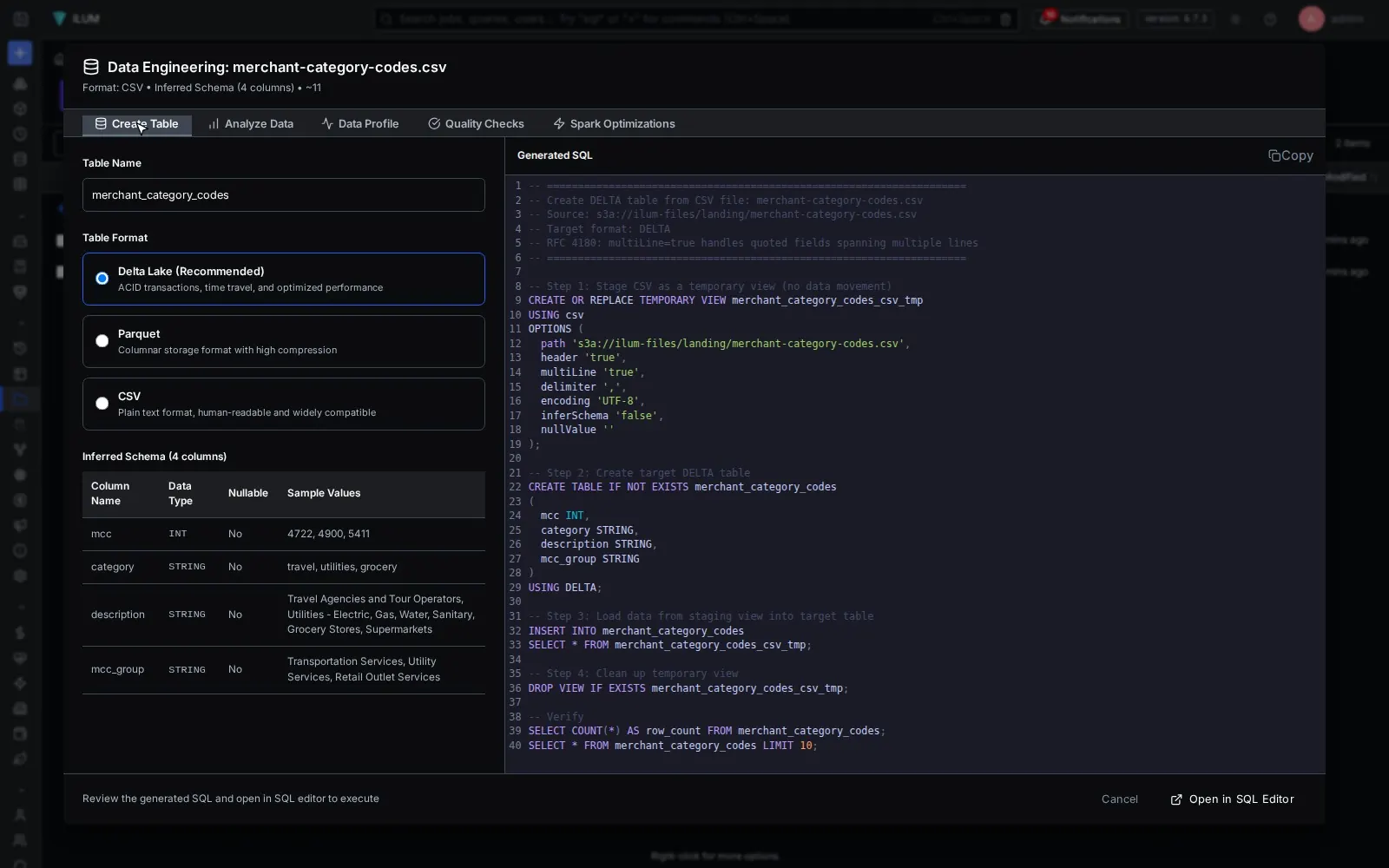
Access control, audit and lineage
Cloudera’s SDX enforces Ranger policies and Atlas lineage, and the weekend carries both as they are. Ilum has roles, LDAP or OAuth2 sign-in, an Event Log and column-level lineage from every Spark job.
SDX: one set of policies and lineage
Ranger shows data as it is, obfuscated or hidden, and Atlas adds lineage and classification.
Kept through the weekend
Principals stay, Ranger plugins are connected again and the Atlas hooks keep lineage flowing.
Four roles, LDAP and OAuth2 in Ilum Community
ADMIN, DATA_SCIENTIST, DATA_ENGINEER and USER are seeded on start, and sign-in can come from your directory or your OpenID Connect provider.
OpenLineage in every Spark job
Ilum adds the OpenLineage listener to every job and keeps what it sends in Marquez, down to single columns (follow one column).
Access and lineage in detail
- SDX. Cloudera describes SDX as unified security, governance and metadata.
- Through the weekend. auth_to_local rules stay with the principals, Ranger policy content is compared before and after the cutover, and the hooks are those of Hive, HBase, Sqoop, Impala and Spark.
- In Ilum. The Event Log names who did what, down to the API token. Apache Ranger is an Enterprise module.
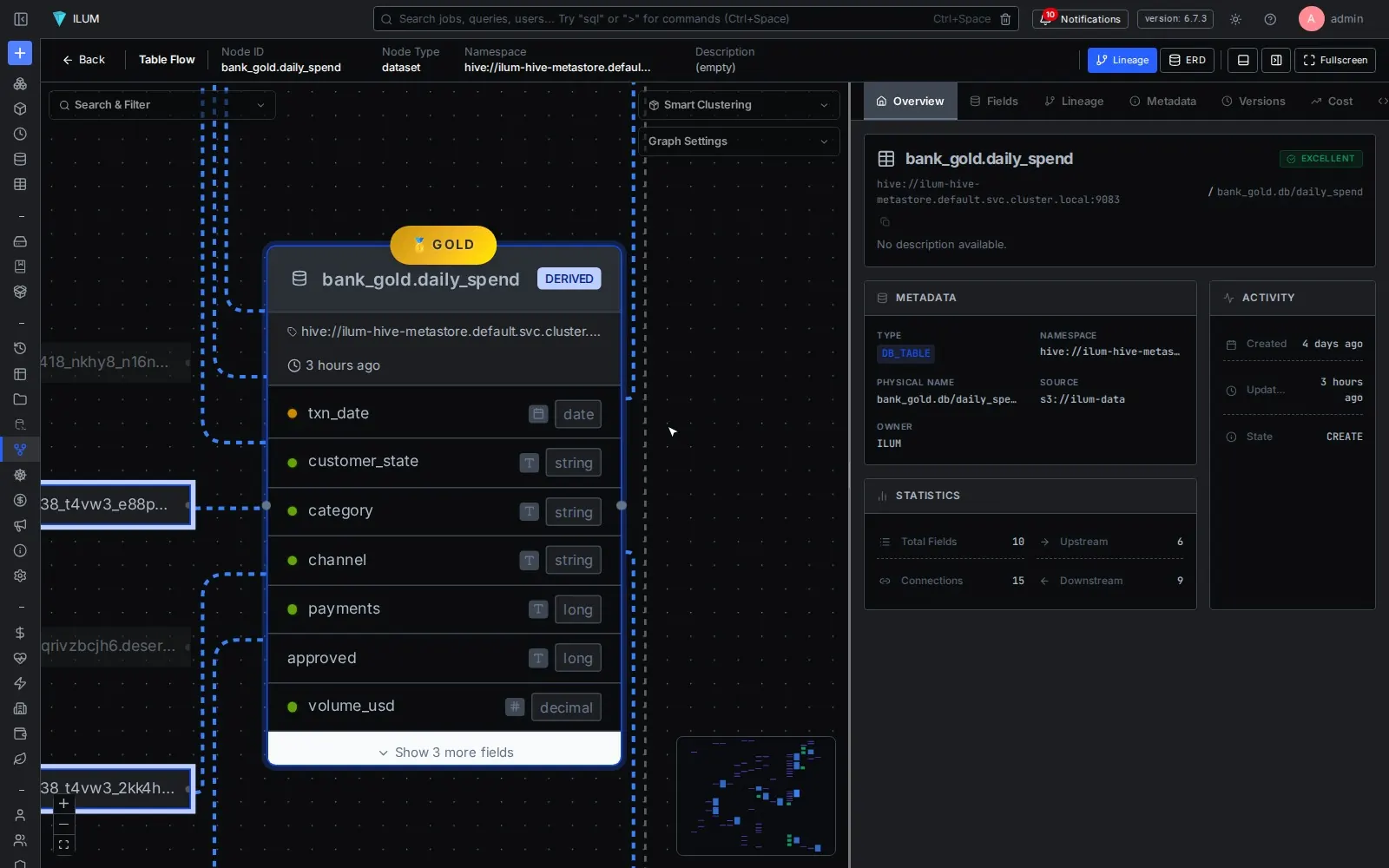
Notebooks, jobs and schedules
On Cloudera, Hue edits SQL and designs Oozie workflows, which Oozie starts on a schedule. Ilum ships Jupyter on Spark, runs jobs, services and cron schedules, and installs Airflow as a module.
Hue and Oozie on Cloudera
After the weekend both run as before, with Oozie’s share library carried.
Jupyter on Spark in every Ilum install
Ilum’s JupyterLab reaches Spark through Sparkmagic, so a cell runs on the cluster (how a cell reaches Spark).
Jobs, services and cron schedules
A job is one Spark application, a service keeps Spark running between calls, and a schedule fires a job from a Kubernetes CronJob (how a schedule fires).
Oozie becomes Airflow when you modernize
Bifrost’s converter turns Oozie workflows into Airflow 3 DAGs with dbt models for the SQL actions.
Notebooks and schedules in detail
- Hue and Oozie. Hue is the query editor that submits SQL and designs Oozie workflows. Oozie coordinators fire workflows by time and by data availability.
- Notebook modules. Zeppelin is a module of Ilum, JupyterHub an Enterprise module.
- Orchestrators. Airflow is a module of the same Ilum release, beside Kestra, Mage, n8n and NiFi.
What does leaving Cloudera cost?
Cloudera’s license alone costs at least $10,000 per node a year. A Classic weekend removes it.
On premises: an annual subscription
Cloudera lists its on-premises offerings as annual subscriptions with business support.
Classic: the hardware you already have
The topology, the bare-metal footprint and the data stay, so the weekend needs no new cluster, and Cloudera licensing is removed.
Ilum Community: no fee, and you run it
No platform fee, and your team runs Kubernetes and Ilum.
The cost in detail
- On premises. Cloudera’s subscriptions include technical support and version, maintenance and security updates.
- After Classic. No Cloudera subscription afterwards. Bifrost itself is a commercial component of Ilum Enterprise.
The Cloudera license alone, a year
10 nodes × at least $10,000 per node a year
Cloudera on premiseslicense only, at least
$100,000 a year
After a Classic weekendthe same hosts, open-source Hadoop
no Cloudera license
50 nodes × at least $10,000 per node a year
Cloudera on premiseslicense only, at least
$500,000 a year
After a Classic weekendthe same hosts, open-source Hadoop
no Cloudera license
100 nodes × at least $10,000 per node a year
Cloudera on premiseslicense only, at least
$1,000,000 a year
After a Classic weekendthe same hosts, open-source Hadoop
no Cloudera license
200 nodes × at least $10,000 per node a year
Cloudera on premiseslicense only, at least
$2,000,000 a year
After a Classic weekendthe same hosts, open-source Hadoop
no Cloudera license
300 nodes × at least $10,000 per node a year
Cloudera on premiseslicense only, at least
$3,000,000 a year
After a Classic weekendthe same hosts, open-source Hadoop
no Cloudera license
License only, at least $10,000 per node a year. Bifrost is a commercial component of Ilum Enterprise.
Cloudera, CDP, CDH, Cloudera Manager, Apache Hadoop, Hive, Impala, Spark, Iceberg, Oozie, Ranger, Atlas, Ambari, Bigtop, Amazon Web Services and AWS are trademarks of their owners. They are named here only to compare the products, from the owners’ public pages. Ilum is not affiliated with or endorsed by any of them.
Questions and answers
How is Ilum different from Cloudera?
CDP Private Cloud Base runs on hosts you operate, under Cloudera Manager and a Cloudera license, and Cloudera on cloud is managed by Cloudera from its own control plane. Ilum Community runs every part on a Kubernetes cluster you operate, with no platform fee. Between the two, Bifrost’s Classic path moves a CDP or CDH cluster to open-source Hadoop in place, and Ilum on Kubernetes can follow, table by table, at your own pace.
How long does a Cloudera migration take?
Leaving Cloudera with Classic takes at least two to four weeks of preparation on the live cluster, then one planned weekend per cluster for the cutover: stop-and-swap typically runs 4 to 8 hours on 17 nodes and 8 to 16 on 29, and has cut over clusters of more than 200 nodes in one weekend in production. Where HDFS has to stay online, shrink-and-grow moves nodes in batches over days instead. Moving on to Ilum on Kubernetes with Modernize or Direct is a phased program of two to five months, table by table.
Can I keep my HDFS data where it is?
Yes. Classic never touches the data directories and reformats nothing, and on the default target HDFS keeps its layout. Ilum reads and writes HDFS as well, and Modernize leaves HDFS data intact until it is decommissioned, after 30 days without a read or a write.
What happens to Hive and Oozie?
Over the weekend both stay: the Hive Metastore database is re-pointed in place, and Oozie is carried as it is with its share library. Modernize later converts the tables to Iceberg behind Trino and the Oozie workflows to Airflow 3 DAGs with dbt.
Can we roll back?
Yes, until you finalize. A cutover that misses its abort gates goes back automatically. The way back takes about 2 hours after the package swap and about 4 once services run, and it stays open through a five-day soak. The finalize command is a separate, manual step that asks you to confirm it is irreversible and accepts only a recent PROCEED of validate-post.
Do we need Kubernetes?
Not to leave Cloudera. Classic lands open-source Hadoop on the hosts you have, managed by Apache Ambari. Ilum itself runs only on Kubernetes, on bare metal, OpenShift or Rancher as well as in a cloud, so Modernize and Direct need a Kubernetes cluster and S3-compatible object storage.
Is Ilum open source?
No. Ilum Community runs on a free-tier license key, and it is built on open-source engines: Apache Spark, Trino, DuckDB, Apache Kyuubi, the Hive Metastore and Marquez. What a Classic weekend lands is open-source Hadoop: the Ilum Bigtop distribution, managed by Apache Ambari (Ilum build).
Is CDH still supported by Cloudera?
Cloudera’s lifecycle policy gives March 2022 as the end of support of Cloudera Enterprise 6.3, and its limited support for CDH 6.2 and 6.3 ended on September 30, 2022. Classic takes CDH 6 clusters in place too, turns Sentry roles into Ranger policies and upgrades the metastore schema to Hive 3.
Where do Cloudera parcels come from?
Parcels for production come from Cloudera’s archive, which asks for an active subscription agreement and the credentials of its license key. After a Classic weekend the cluster runs RPM packages of the Ilum Bigtop distribution, installed from a package mirror staged on every node.
What happens when a Cloudera license expires?
Cloudera’s documentation says the Admin Console of Cloudera Manager locks until a valid license is uploaded, while the clusters keep running and the data stays intact. After a Classic weekend there is no Cloudera license to expire.
Can our scripts and tools keep their Cloudera paths?
Yes. Every parcel’s bin and lib entries are linked into the new installation, so paths under /opt/cloudera/parcels keep resolving, spark3-submit still means Spark 3, and Ambari can answer on Cloudera Manager’s ports 7180 and 7183 for bookmarks and integrations.
How does a Bifrost migration start?
Write to [email protected]. Bifrost is a commercial component of Ilum Enterprise, and a migration starts with discovery through a read-only Cloudera Manager account, first on a non-production cluster. Discovery and the checks before the window change nothing and can run on a live production cluster.
Contact
Tell us about your cluster.
Name one workload you want to move.
Tell us where it runs today.
We answer with a plan, not a deck.
We reply within two working days.